tranzit.org assembly vienna
tranzit.org will meet in Vienna on December 4, 2026, for an evening that will feature performances, conversations, and a book launch / cz /

Taking place at the Angewandte Interdisciplinary Lab (AIL), the program takes an interwoven form, combining two conversations with a series of eight artistic and performative contributions.
read more /
Asparagus Time writing workshop
Anna Tudos / ro /

Saturday, November 7
12:00 – 17:00
The Experimental Station for Research on Art and Life
Intr. Primăverii 10, Siliștea Snagovului
How can we cultivate ways of attention to more-than-human worlds entangled in eating? In what ways can the experience of encountering and attuning to edible plants be translated and retold?
These are the questions at the heart of Anna Tudos’ research, exploring the asparagus plant, a plant that is mostly identified in its commodity form: the white or green spear. Asparagus’s hyperreal image is constructed around seasonality, traditionalism, and atmospheres of whiteness and elitism, while its cultivation is entangled in extractive land-use regimes and physically draining seasonal agricultural work. The project aims to translate this complex assemblage of relations into encounters through a lens of plant temporality, proposing that by attending to the rhythms and cycles of plants, we might begin to recognise how their temporalities shape human practices and relations, and how plants themselves exercise relational agency.
The workshop creates a speculative connection between the South Tyrolean asparagus and the asparagus plant growing at the Experimental Station. This perennial plant sends up edible shoots every year with bursting power, and come November, it turns yellow, transferring its energy down into its root system. Through exercises in non-linear writing, together we will tune into the rhythms of this unique plant and explore how waiting, returning and decomposing play a role in our plant-human relationships. In this moment of autumnal transformation, we will make a souvenir to remember the asparagus by and perform a collective action: covering the inhabitants of the garden in protective textile in a gesture of care for the winter.
read more /
Food Sovereignty and the Agroecological Transition: A Conversation with Roxana Triboi
ro /

Saturday, November 7
12:00 – 17:00
The Experimental Station for Research on Art and Life
Intr. Primăverii 10, Siliștea Snagovului
Who holds the power when it comes to our daily food? How is power structured within the food sector? Who has access to good food in Romania’s cities, and how much room is there for autonomous initiatives by residents? In this conversation with Roxana Triboi, we will discuss about food sovereignty in the urban context, the relationships with institutions, and the decolonization of food systems—specifically within the context urban Romania. We will also explore the pathways toward a sustainable future centered on the preservation and cultivation of the commons and agroecological parks.
Coordinated by Ovidiu Tichindeleanu, the conversations in Living Thought aim to introduce contemporary scholars and artists who are working in the emerging field of knowledge and practices relating to land, to indigenous/ancestral knowledges and eco-social realities, and who are proposing not only reviews of problems, but visionary alternative paths. Continuing of the ongoing work of the Experimental Station for Research on Art and Life, the intellectual conversations in Living Thought are tools of conviviality aiming to spark the radical imagination needed to change our relations to culture, to re-orient our sense of the world, and to regain an ethical life outside the ongoing war on life.
read more /
Clay as a Memory of Landscape
Participatory workshop with Terezie Tomková / sk /

𓂅 When? November 5, 2026, 5:00 PM
𓂅 Where? tranzit.sk, Beskydská 12, Bratislava
What can clay remember? The touch of hands, the pressure of fingers, the place it comes from? This workshop invites us to explore the relationship between body, material and landscape. Clay becomes a medium for perception and a carrier of memories: it holds impressions, dries, cracks and changes.
✧ The number of places is limited. To register, please email studyroom.tranzit@gmail.com by November 4. ✧
read more /
Feminist Spatial Practices in Times of Climate Collapse
Lecture and discussion with guest Tatjana Schneider / sk /

When? 3 November 2026, 6 p.m.
Where? tranzit sk, Beskydská 12, Bratislava
Guest: Tatjana Schneider
Moderated by: Lýdia Grešáková
This event is part of the Space for the 99%: Contemporary Slovak and Czech Spatial Practices exhibition and will be held in English.
read more /
Kateryna Iakovlenko
Curator-in-Residence November–December 2026, Ukraine /

read more /
Open Call: Artist at Risk Residency in Vienna, Angewandte Interdisciplinary Lab (AIL)
at /

Together with the University of Applied Arts Vienna, the Angewandte Interdisciplinary Lab (AIL) offers a one-month residency programme (February 8 to March 8, 2027) for artists from Ukraine to develop interdisciplinary projects with a strong focus on research.
read more /
More than 20 Years of tranzit.org
Lecture-performance by Norbert Kuki and launch of the tranzit 20+ book / sk /

When? 16 October 2026, 6 pm
Where? tranzit.sk, Beskydská 12, Bratislava
Registration is not required for attending the lecture-performance and the book presentation.
An accompanying programme of Weaving Space. FSP International Solidarity Festival, Bratislava edition
More than twenty years of tranzit is an occasion to celebrate a long-term practice of cooperation, exchange and solidarity across Central and Eastern Europe. What began through the development of independent art initiatives has grown into the tranzit.org network, connecting tranzit.at (Austria), tranzit.cz (Czech Republic), tranzit.hu (Hungary), tranzit.ro in Iași, Bucharest and Cluj (Romania), and tranzit.sk (Slovakia).
read more /
Networks of Cooperation: Sustainable Structures for Ukrainian Cultural Actors in Europe and Beyond
International Conference at Kunsthaus Graz / at /
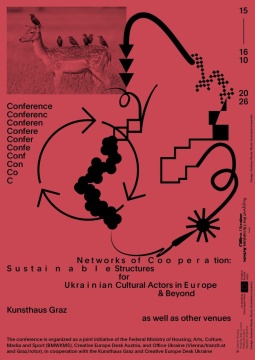
On 15 and 16 October 2026, the international conference Networks of Cooperation: Sustainable Structures for Ukrainian Cultural Actors in Europe and Beyond will bring together cultural institutions, funding bodies, policymakers, artists and experts from Ukraine, Austria and across Europe at Kunsthaus Graz. At the heart of the conference is the question of how the emergency support provided since 2022 can evolve into long-term forms of cultural cooperation.
read more /
Theo Prodromidis: Handles to Another Social Imaginary
ro /

Thursday, October 15
18:00 – 20:00
NON art space
Semilunei 8, Bucharest
What forms of resistance emerge from the margins, where people organize to sustain life amid prolonged crisis? Drawing on experience as an artist working across open practices, non-formal education and solidarity initiatives in Greece, I will reflect on how these encounters have shaped my artistic practice and understanding of art practice as a common infrastructure. From spaces of education and collective learning to struggles around land, water and the commons, I explore how practices of care, participation and mutual support, open entry points into an after-crisis future as the collective iteration of other, more just ways of living together.
Coordinated by Ovidiu Tichindeleanu, the conversations in Living Thought aim to introduce contemporary scholars and artists who are working in the emerging field of knowledge and practices relating to land, to indigenous/ancestral knowledges and eco-social realities, and who are proposing not only reviews of problems, but visionary alternative paths. Continuing of the ongoing work of the Experimental Station for Research on Art and Life, the intellectual conversations in Living Thought are tools of conviviality aiming to spark the radical imagination needed to change our relations to culture, to re-orient our sense of the world, and to regain an ethical life outside the ongoing war on life.
read more /
Weaving Space
FSP International Solidarity Festival, Bratislava edition / sk /

15–16 October 2026, tranzit sk, Beskydská 12, Bratislava, Slovakia
This two-day festival unfolds within the collective exhibition Spaces for the 99%: Contemporary Slovak and Czech Spatial Practices (Priestor pre 99 %: Súčasná slovenská a česká miestotvorba), which presents artistic and interdisciplinary practices that expand how architecture engages with care, environment, and local context.
read more /
Press release: The 2026 Biennale Matter of Art has closed. More than 19,000 people came to see Necessary Wishes
cz /

The fourth edition of the Biennale Matter of Art, titled Necessary Wishes, closed on 26 September. The exhibition and accompanying program at the National Gallery Prague – Trade Fair Palace, GAMPA – City Gallery Pardubice, and the Tusculum Prague art centre drew a total of 19,830 visitors. Curated by Jaroslava Tomanová, Jakub Gawkowski, and František Fekete, the biennale presented forty-nine artists and collectives from twenty countries, including six newly commissioned works, and offered sixty-one events over the course of three and a half months. Admission to the exhibition and all events was free of charge.
read more /
Imagined Organisations: Practices of Artistic Research Moving Across Semiperipheries
Biennale Matter of Art
The project comprises the international exhibition of contemporary art taking place once every two years as well as the platform’s long-term activities, which engage in critical reflection of the institutional aspects of the biennale format in the / cz /
read more /
The Space of Opportunity is open
Community space under 63 Práter Street / hu /
read more /
Revolting with Care
Research, publishing, workshops, discussion forums / sk /
read more /
ERSTE Foundation is the main partner of tranzit:
